
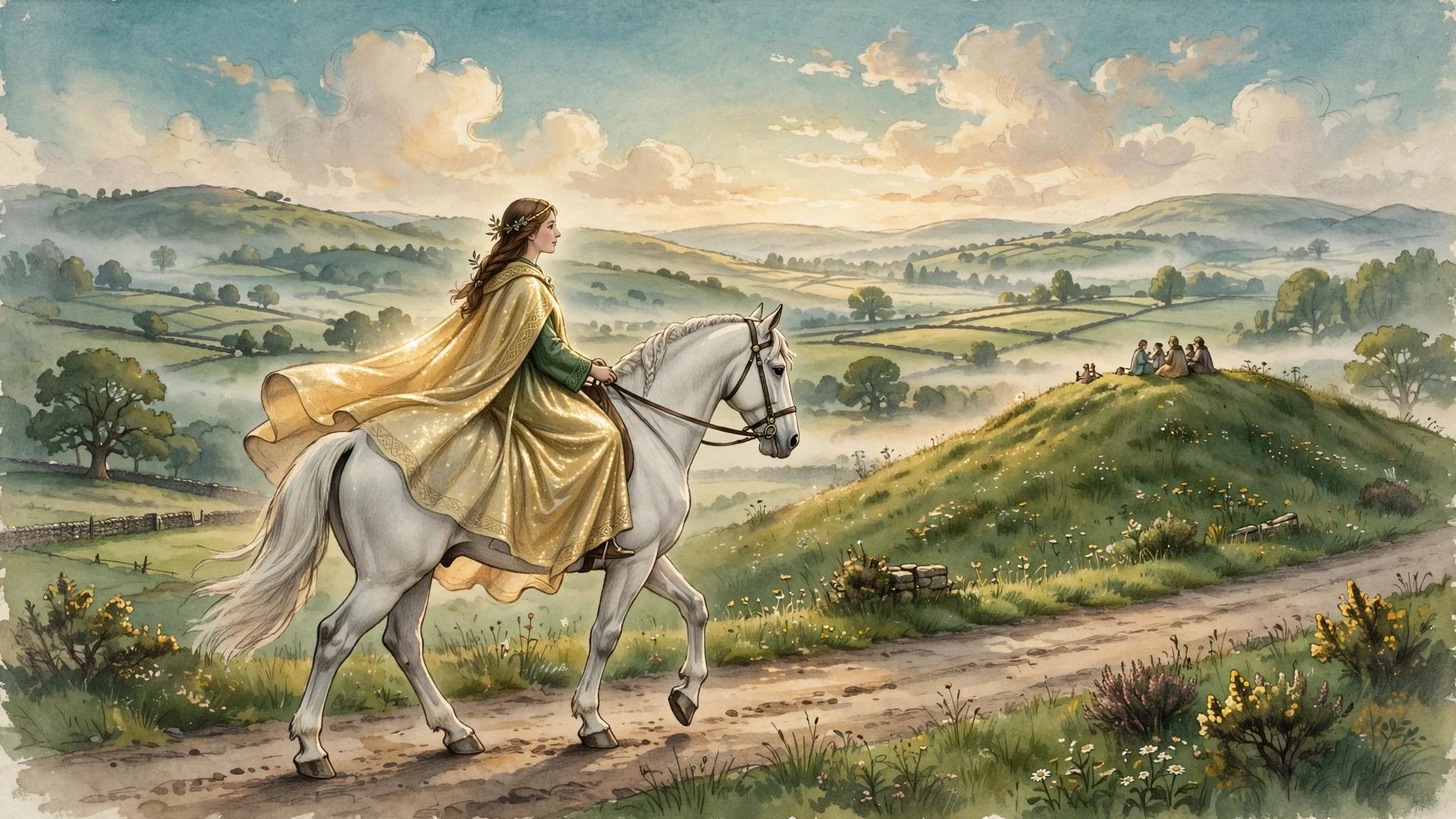
Some horses in old stories are remembered for their color. Rhiannon's horse is one of them. In the medieval Welsh tale Pwyll Prince of Dyfed, a pale-white horse walks along a path at an easy, even pace, and three days of riders cannot catch up with it. Then the story turns, and horses keep turning up in it: a tired horse, a mysterious mare, and a foal that matters more than anyone expects.
A rider in gold on a pale-white horse
Pwyll, lord of Dyfed, is at his court at Arberth when he decides to sit on a nearby mound, Gorsedd Arberth. One of his courtiers has warned him about it: anyone of high birth who sits there will leave with either wounds and blows or the sight of a marvel. Pwyll says he is not worried about blows with his whole household around him, and he would be glad to see a marvel.
The marvel arrives. A woman in a garment of shining gold silk comes along the track past the mound, riding a large, stately, pale-white horse. The translation says the horse keeps an even, leisurely pace. Nobody recognizes her, so Pwyll sends a man to find out who she is.
Three days, three tries, one tired horse
The first man goes on foot. The harder he runs, the further ahead she seems to be. Pwyll sends him back for the fastest horse he knows, but it makes no difference. The horse flags, and the rider returns with his report: no horse in the land is faster than this one, and it still could not close the gap.
The next day Pwyll's company returns to the mound with another of the fastest horses in the field. The woman passes by on the same horse, in the same clothes, at the same pace. The rider tries a slow amble and then loosens the reins, and he gets no closer. Pwyll decides she must have a message for someone, if only she would stop to give it.
On the third day Pwyll has his own horse saddled and brought to the path. When the woman appears, he mounts and goes after her, and she is already past him. He spurs the horse as hard as it will go. Still nothing. At last he calls out, and what he says works where all the spurring failed:
"Maiden, for the sake of the man you love the best, wait for me!"
She stops at once. "Gladly I'll wait," she tells him, "but it might have been better for the horse if you had asked me a good while before."
It is my favorite line in the tale. After three days of chasing, the person in the story who points out what it cost the horses is Rhiannon herself.
Rhiannon had a plan all along
Rhiannon lifts the part of her headdress that covers her face and tells Pwyll why she came: she had come to see him. She is the daughter of Hyfaidd the Old, and she is being given in marriage to a man against her will. She does not want him unless Pwyll refuses her, and she has ridden out to hear Pwyll's answer. He tells her he would choose her above all women, and she sets a date a year away.
The wedding feast is where Rhiannon's quick mind takes over. A stranger named Gwawl, the man she was meant to marry, appears and asks for a favor, and Pwyll promises it before he knows what it is. Gwawl asks for Rhiannon. Pwyll is stunned into silence, and Rhiannon does not spare him: "There was never a man so slow with his wits as you were just then."
Then she gets to work. She hands Pwyll a small bag that will never fill, tells him exactly what to say and when to blow his horn, and arranges the whole trap herself, from the feast to the ending. The scheme she plans works, and the other suitor is the one left in the bag.
A lost child and a mare that foaled every May
Rhiannon and Pwyll rule Dyfed together, but there is no child, and the people begin to worry. Then a son is born. The women set to watch over mother and baby fall asleep, and by morning the boy is gone. Afraid of what will happen to them, they put the blame on Rhiannon. Pwyll will not send his wife away, but she is given a long penance: she must sit by the mounting block at the gate of the court, tell every passer-by what supposedly happened, and offer to carry visitors to the hall on her back.
Far away, a lord named Teyrnon has a problem of his own. His mare is the most beautiful in his lands, and she foals every year on the night of the first of May. Every year the foal vanishes, and nobody knows where it goes.
This year Teyrnon decides to keep watch. He brings the mare indoors, arms himself, and stays up. The mare gives birth to a large, well-formed foal that is standing within moments. Then there is a great commotion, and a huge claw reaches through the window and grabs the foal by its mane. Teyrnon draws his sword and cuts at the arm, and the foal falls back into the room beside him. He runs out into the dark after the sound, and when he comes back he finds a baby wrapped in a brocaded silk sheet, lying at his door.
Teyrnon and his wife raise the boy as their own and name him Gwri Golden-Hair, for his bright hair. The foal is looked after in the stable. When the boy is old enough to be fond of the horses, always making deals with the stable lads to lead them down to water, Teyrnon's wife has the foal broken in and gives him the horse as his own.
The boy, the horse and the road home
As the boy grows, Teyrnon hears more and more about Rhiannon's penance. He notices that the boy looks remarkably like Pwyll. He and his wife agree that it is wrong to keep him, and the next day Teyrnon sets out for Arberth with two companions and the boy, who rides the horse he was given.
At the gate Rhiannon is sitting by the mounting block, ready to carry them in. Teyrnon tells her none of them will be going on her back, and the boy adds, "Let him go who wants to, but I myself will not go." Inside the hall, Teyrnon tells the whole story of the mare and the boy. The child is named Pryderi, and he grows up to rule Dyfed after Pwyll. Teyrnon is offered treasure, fine horses and dogs for what he did, and he takes none of it.
What the story tells us about the white horse
The tale does not say whether Rhiannon's horse is old or young, or what its coat would be called today. The translator says only "pale-white," and nothing more. In real life, a horse that looks white to the eye can be a gray that has lightened with age, a very pale cream, or, rarely, a truly white horse. You cannot tell which from a description in a story, and this story does not try.
What the tale does give us is a horse people remember: calm, steady, never hurried, and not caught by three days of fast riders. It also gives us a mare and foal that help bring a lost child back to his mother.
Read the original
This retelling follows Parts II and III of the Mabinogi of Pwyll in the translation at Mabinogi.net. Other translations vary in their wording, and the full tale has more adventures than a blog post can hold. You can read it all here: The Mabinogi of Pwyll.
If stories about colorful horses make you wonder what your own mare and stallion might produce, try the Foal Color Predictor. It turns coat genetics into simple probability estimates you can use at the barn.
